

If every step feels like it's grinding bone on bone, you may be facing a decision that once meant only one option: ankle fusion surgery. Today, ankle replacement is also on the table, and choosing between the two can feel overwhelming when your ankle pain is already limiting your ability to walk, work, or stay …


If every step feels like it’s grinding bone on bone, you may be facing a decision that once meant only one option: ankle fusion surgery. Today, ankle replacement is also on the table, and choosing between the two can feel overwhelming when your ankle pain is already limiting your ability to walk, work, or stay active. At Wisconsin Foot & Ankle Clinic, our foot and ankle care team treats both conditions regularly, and while the two procedures address the same underlying problem, they get there in very different ways.
Ankle fusion permanently joins the bones of the ankle joint together, eliminating motion at the joint entirely. Ankle replacement swaps out the damaged joint surfaces for an artificial implant, aiming to preserve some natural movement. Neither option is automatically “better.” The right choice depends on your age, activity level, bone quality, and the specific pattern of arthritis affecting your ankle.
This guide breaks down what each procedure involves, why one might be recommended over the other, and what recovery actually looks like so you can walk into that conversation with your surgeon feeling prepared instead of overwhelmed.
What Ankle Fusion Means for Your Ankle Bones
Your ankle joint is where the two bones of your lower leg meet the bone on top of your foot. Smooth cartilage lets these bones glide against each other with every step you take. When arthritis wears that cartilage away, the bones start rubbing directly against one another. This friction is what causes the deep, grinding pain that many patients describe when the ankle joint has been damaged for years.
Ankle fusion, sometimes called ankle arthrodesis, addresses this by removing what remains of the damaged cartilage and fastening the bones together with screws or plates. As they heal, the bones grow into one solid bone, which eliminates the joint motion that was causing pain in the first place.
Common Causes That Lead to Ankle Fusion Surgery
Most patients who end up considering ankle fusion surgery have tried other treatments first. What’s driving the arthritis determines why fusion or replacement gets recommended over continuing conservative care.
Arthritis and Long-Term Wear
Osteoarthritis is the most common reason patients need advanced treatment for ankle arthritis. Years of wear and tear gradually break down the cushioning cartilage until the joint becomes painful and stiff, especially with activity or after long periods of standing.
Rheumatoid arthritis and other inflammatory conditions can also damage the ankle joint, often more aggressively and at a younger age than typical osteoarthritis. In these cases, the joint lining itself attacks healthy cartilage, accelerating the damage.
Regardless of the cause, once enough cartilage is gone, the bones meet directly and every step becomes painful. This is usually the point where surgical options start to make sense.
Injury, Deformity, and Failed Treatments
Post-traumatic arthritis develops after a serious ankle fracture or severe sprain, even years after the original injury has healed. The joint surfaces never quite realign the way they did before the trauma, and arthritis sets in over time.
Severe deformity of the ankle, low bone density, and previous failed treatments (including a failed ankle joint replacement) can also point toward fusion as the more reliable option. When bone quality is compromised, fusion often gives a more durable, predictable outcome than an implant.
Symptoms and Warning Signs of Advanced Ankle Arthritis

Ankle pain that started as an occasional ache after activity often becomes a daily struggle as arthritis progresses. Many patients notice the pain is worse first thing in the morning or after sitting for a while, then eases slightly once they get moving. Stiffness is another hallmark symptom. The ankle may feel locked or resistant to movement, particularly when trying to flex the foot up and down.
Swelling around the joint, especially after walking or standing for extended periods, is common as the irritated tissue reacts to the friction inside the joint. Some patients also notice a grinding or catching sensation with certain movements.
Warning signs that shouldn’t be ignored include pain that wakes you from sleep, an ankle that gives way or feels unstable when you walk, and pain that no longer responds to rest, ice, or over-the-counter anti-inflammatory medication.
How Foot and Ankle Specialists Diagnose the Problem
Your foot and ankle doctor will start by asking about your symptoms: how long they’ve been present and how much they’re limiting your daily life. A physical exam helps your foot and ankle doctor assess your range of motion, stability, and where exactly the pain is coming from.
X-rays are typically the first imaging tests ordered, since they clearly show how much joint space remains and how far the arthritis has progressed. Magnetic resonance imaging can add a more detailed look at the ankle joint and surrounding soft tissue when the X-rays don’t tell the whole story.
This full picture, including your activity goals and overall bone health, is what allows your surgeon to recommend the treatment option most likely to work for your specific situation, rather than a one-size-fits-all approach.
Treatment Options for Severe Ankle Arthritis
Surgery is never the first step. Here’s the full range of ankle surgery options and when each one becomes appropriate, so you know what to expect next.
Conservative Care Comes First
Most patients start with conservative therapy: anti-inflammatory medication, bracing, activity modification, and sometimes corticosteroid injections into the joint. These nonsurgical treatments don’t reverse arthritis, but they can meaningfully reduce pain for months or years.
When these measures no longer provide adequate relief and the pain is affecting your ability to work, exercise, or simply get through the day, surgical treatment becomes the next reasonable step.
Ankle Fusion Surgery: What to Expect
During ankle fusion, your ankle surgeon removes any remaining cartilage and positions the bones so they can heal together. Screws or plates hold everything in place while fusion occurs, and a bone graft, often taken from the heel bone or pelvis, sometimes helps encourage the bones to heal.
Most ankle fusions are performed as open surgery, though some patients are candidates for a minimally invasive technique using a tiny camera and smaller incisions. The detailed overview of ankle fusion surgery covers how surgeons choose between these approaches based on the severity of deformity involved.
The procedure itself typically takes a few hours, generally in the 1.5 to 3 hour range, and most patients go home the same day in a splint or plastic boot. Recovery is measured in months rather than weeks: patients usually avoid putting weight on the operated leg for around 6 to 8 weeks, and it can take up to 4 to 6 months for a fully healed, solid bone.
Ankle Replacement Surgery: What to Expect
Ankle replacement surgery takes a different approach. Rather than eliminating joint motion, the surgeon removes the damaged joint surfaces and replaces them with a metal and plastic implant designed to preserve range of motion. This option tends to appeal to patients who want to maintain a more natural walking pattern and who have good bone quality to support the implant. It’s a newer technology than fusion, and long-term durability continues to improve as implant designs advance.
Recovery after replacement allows for an earlier, gentler return to weight-bearing activity than fusion, though high-impact activities are still discouraged to protect the implant over time.
Ankle Fusion vs. Ankle Replacement: How to Decide
Younger patients and those with high physical demands sometimes lean toward fusion because a fused ankle is remarkably durable once healed. Many patients return to physically demanding jobs and long walks, though running and high-impact sports are usually not recommended afterward.
Older patients, or those who prioritize preserving natural ankle motion and have adequate bone density, may be better candidates for replacement. The specialty resources on ankle fusion note that either procedure can effectively treat arthritis, and the right call often comes down to lifestyle goals as much as the arthritis pattern itself. Bone quality matters too. Patients with low bone density, significant deformity, or a history of infection are frequently steered toward fusion, since it doesn’t rely on an implant integrating with weaker bone the way replacement does.
There’s no universal right answer here. The best treatment option is the one that matches your anatomy, your activity goals, and your surgeon’s assessment of what will hold up best over the years ahead.
Recovery Timeline After Ankle Fusion
Immediately after surgery, keeping the foot elevated above heart level, often in a reclined position, helps control swelling. Pain medication is typically prescribed for this early period, and most patients rely on crutches or a walker for up to a few months.
Physical therapy usually begins once the bones show signs of healing well, often around the 10 to 12 week mark, and focuses on regaining strength and motion in the nearby joints that took over some of the ankle’s workload. Swelling can persist for up to six months as the fused ankle continues to settle.
The good news for most patients is that the fused bones become extremely reliable once healed. Nonunion, where the bones fail to fuse properly, occurs in about 5 percent of cases, and infection risk stays low with modern surgical techniques.
When to See a Foot and Ankle Doctor
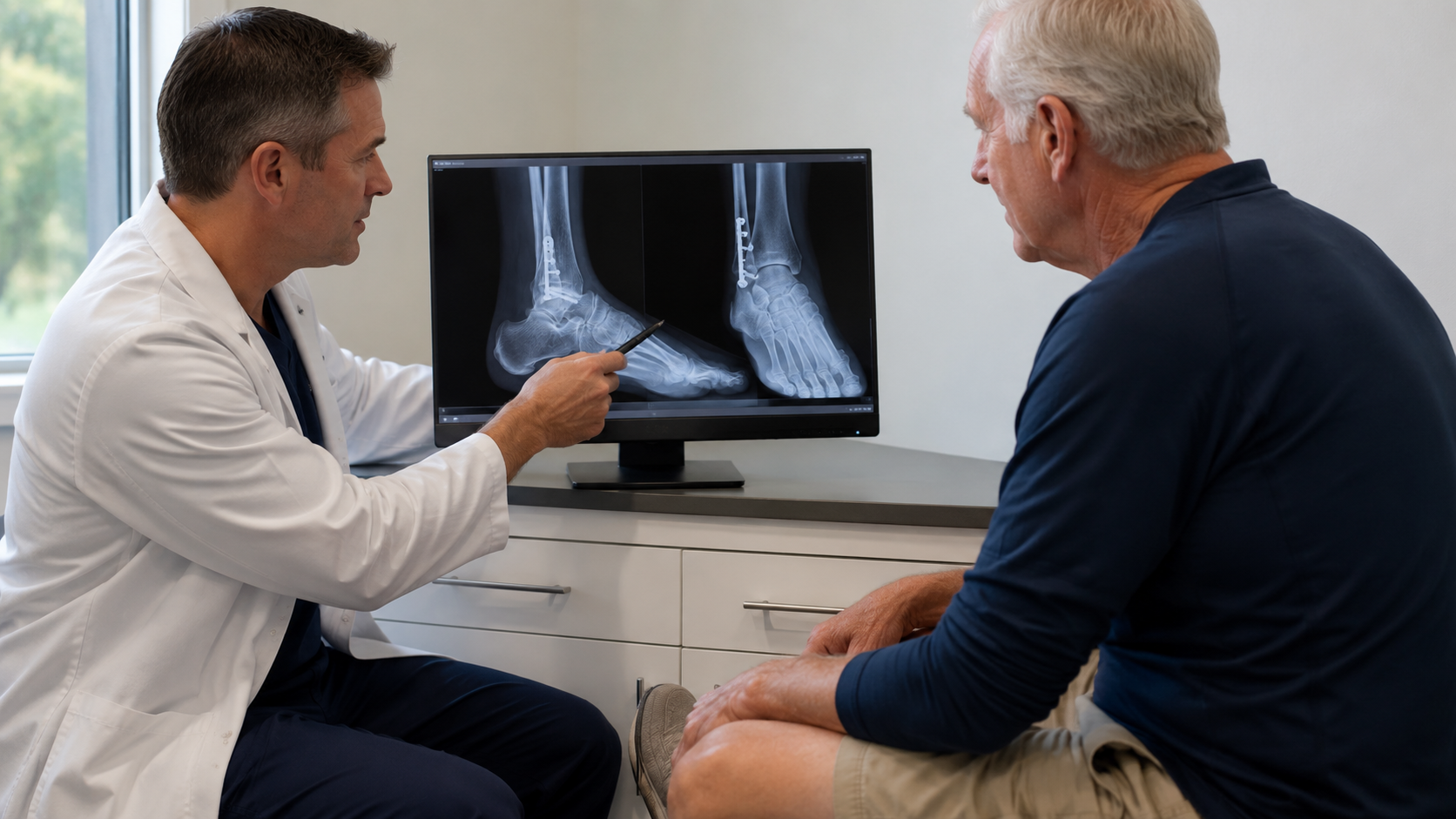
If ankle pain is limiting how far you can walk, keeping you up at night, or no longer responding to rest and over-the-counter anti-inflammatory medication, it’s time to have it evaluated. Waiting often means the arthritis progresses further before treatment even begins. An ankle that feels unstable, gives way unexpectedly, or shows visible swelling that doesn’t improve with elevation deserves prompt attention as well. These can be signs the joint damage has reached a point where nonsurgical treatments won’t be enough on their own.
Even if you’re not sure whether your symptoms warrant surgery, an evaluation can clarify where you stand and what options exist, from bracing and injections to fusion or replacement, before your pain forces the decision for you. Deciding between ankle fusion and ankle replacement is rarely simple, and it shouldn’t be made alone. Both procedures can relieve years of chronic pain, but they take very different routes to get there, with different tradeoffs for your long-term mobility.
The right foot and ankle specialist will walk you through your imaging, your activity goals, and your bone health before recommending one path over the other. There’s no rush to decide before you have all the information in front of you.
If ankle pain has been holding you back, reach out to our office. Our team treats both ankle fusion and ankle replacement patients regularly, so we can walk you through which path fits your ankle and the life you want to keep living.


