

You twisted your ankle, but there's no puffiness or bruising. It still hurts, though, and that mismatch can be confusing since most people assume a real sprain always comes with obvious swelling. An ankle sprain without swelling is more common than most people realize, and ignoring it can let a minor injury turn into a …


You twisted your ankle, but there’s no puffiness or bruising. It still hurts, though, and that mismatch can be confusing since most people assume a real sprain always comes with obvious swelling.
An ankle sprain without swelling is more common than most people realize, and ignoring it can let a minor injury turn into a lingering problem. This guide covers what it usually means, what causes it, and when it’s time to have a foot and ankle specialist take a look.
What Ankle Sprain Without Swelling Means
Ligaments hold your ankle bones together, and a sprain happens when one or more of them get stretched or partially torn. Swelling is a typical response to that damage, but it isn’t guaranteed. Some sprains are mild enough that the tissue never reacts strongly, and others involve ligaments in a spot where swelling doesn’t build up the same way.
A sprained ankle without noticeable puffiness is usually either a mild Grade I injury or a high ankle sprain. Both can still involve real ligament damage, so it’s worth having a professional confirm what you’re dealing with rather than assuming it’s minor.
Common Causes
How much force was involved, and how the ankle twisted, largely determines the type of sprain. A controlled misstep tends to stress the ligaments less than a hard fall or a sharp pivot during sports.
Mild Missteps and Everyday Movements
A lot of these injuries happen during ordinary moments. Stubbing your toe, stepping off a curb wrong, or catching your foot on uneven ground can strain the ligaments just enough to cause pain without much inflammation.
These mild sprains usually involve a small amount of stretching rather than a partial tear, so the ankle joint absorbs some stress but not enough to bring on the redness or puffiness people expect.
High Ankle Sprains
Instead of the outer ankle ligaments, this type involves the ligaments connecting the tibia and fibula. Instead of the ligaments on the outside of the ankle, they affect the ligaments connecting the tibia and fibula just above the ankle joint, and they typically result from external rotation or a dorsiflexion type of trauma during sports involving cutting or sudden direction changes.
These sprains account for roughly 14 percent of ankle sprains overall, and they’re notorious for not causing much visible swelling even when the ligament damage is real. Athletes sometimes underestimate them for exactly that reason.
Symptoms and Warning Signs

Even without swelling, a sprain usually announces itself in other ways. Localized pain and tenderness right over the ligament are common early signs, and they tend to get worse with movement.
What You Might Notice
Stiffness is a common complaint, especially first thing in the morning, along with mild instability, like the ankle could give out during a quick turn even though it looks completely normal. With a high ankle sprain specifically, pain often radiates up the lower leg rather than staying at the ankle joint, and bearing weight usually makes it worse.
Signs That Point to Something More Serious
Some symptoms deserve more attention. Severe pain, visible deformity, or an inability to bear weight at all suggests something beyond a mild sprain, possibly a partial tear or a fracture. A reduced range of motion that doesn’t loosen up after a day or two is worth mentioning to a specialist, as is instability that keeps happening on uneven ground. It’s easy to dismiss these signals when there’s no bruising to back them up.
How It Is Diagnosed
A hands-on exam tells us more here than how the ankle looks. A foot and ankle specialist will ask how the injury happened and where exactly it hurts.
Physical Examination
During a physical exam, your provider will check tenderness along specific ligaments, test your range of motion, and compare the injured ankle to the uninjured one. For a suspected high ankle sprain, they may gently squeeze the lower leg bones together to see if that reproduces your pain. A specific tender spot often points clearly to which ligament is involved, more than swelling ever would.
Imaging When Needed
If there’s any concern about a fracture or a more severe tear, we’ll order imaging to get a clearer look. An X-ray can rule out broken bones, while an MRI gives a clearer look at the ligaments and soft tissue when exam findings are ambiguous.
Treatment Options
The goal is the same regardless of swelling: protect the ligament while it heals. The goal is to protect the ligament while it heals and avoid pushing through pain.
Conservative Care First
Rest, ice, compression, and elevation remain a solid starting point, even without obvious puffiness to reduce. An ankle brace or compression wrap can add support while you’re up and moving, and topical painkillers can help with discomfort in the first few days. Mild sprains often improve within a couple of days with this kind of care, and once the sharpest pain settles, gentle stretching helps restore full range of motion.
When More Advanced Treatment Is Needed
High ankle sprains and more severe injuries usually need a longer, more cautious approach. Limited weight bearing, a more substantial brace, and a slower return to activity all help protect ligaments that take longer to heal than a typical sprain. Physical therapy is often recommended, focusing on strength and balance to prevent the ankle from becoming a repeat problem, and in rare cases involving a completely torn ligament, surgery may come up as an option.
When To See a Foot and Ankle Doctor
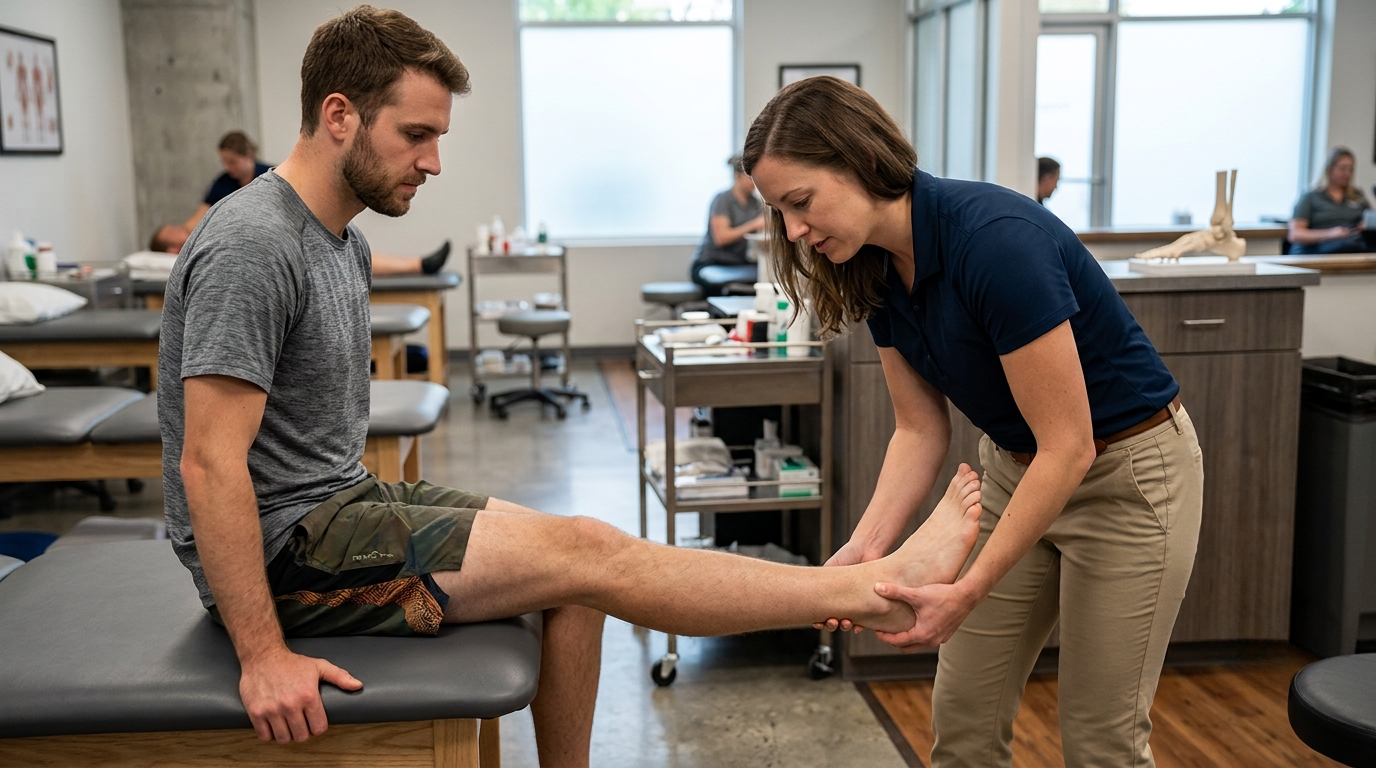
If pain lingers more than a few days without improvement, or if you’re limping to avoid putting weight on the ankle, it’s time to get it checked. The absence of swelling doesn’t mean the absence of a real problem, and waiting too long can let instability become a long-term pattern.
You should also seek care sooner if you hear or feel a pop at the time of injury, notice numbness, or have pain concentrated directly over the bone. These can signal a fracture or a more significant tear that needs a proper medical evaluation.
An ankle sprain without swelling is still a real injury, and it deserves a real diagnosis. Catching it early is what keeps you walking normally instead of dealing with instability months later.
At Wisconsin Foot & Ankle Clinic, we regularly evaluate sprains that look mild but still need imaging or bracing to heal properly. An early visit is what keeps a two-day recovery from turning into a two-month one.


