

If chronic foot or ankle pain has slowed you down for months, you've probably already tried the basics: rest, stretching, maybe an over-the-counter insert. When those steps stop working, the next option your doctor mentions might not be surgery or another round of injections. It could be shockwave therapy. The shockwave therapy benefits for foot …


If chronic foot or ankle pain has slowed you down for months, you’ve probably already tried the basics: rest, stretching, maybe an over-the-counter insert. When those steps stop working, the next option your doctor mentions might not be surgery or another round of injections.
It could be shockwave therapy. The shockwave therapy benefits for foot and ankle pain are significant enough that more patients are asking for this treatment by name before they’ll even consider going under the knife.
At Wisconsin Foot & Ankle Clinic, we’ve watched interest in shockwave therapy grow steadily among patients dealing with plantar fasciitis, Achilles tendinopathy, and other stubborn sports injuries and chronic injuries that just won’t quit on their own. It makes sense why. This treatment targets the source of the pain instead of just masking it, and it does that without an incision, a needle, or weeks spent off your feet.
Below, we’ll walk through what shockwave therapy actually is, which foot and ankle problems it tends to help most, and the six benefits that make it worth a serious look before you consider anything more invasive.
What Is Shockwave Therapy?
Shockwave therapy, sometimes called extracorporeal shockwave therapy, is a non invasive treatment that uses high energy acoustic waves to jump-start your body’s own healing process in an injured area. A trained provider places a small handheld device against the skin over the treatment area and delivers a series of focused pulses.
Each session usually lasts 15 to 30 minutes, and most patients describe it as mild discomfort rather than real pain. Unlike many medical procedures, no anesthesia or sedation is required, so you can drive yourself home the same day.
The technology itself isn’t new or experimental. Shockwave treatment has roots in lithotripsy, the same acoustic wave principle once used mainly to break up kidney stones. Over the past two decades, sports medicine specialists and physical therapists have adapted that same energy for soft tissue healing instead, and it has been studied for conditions like plantar fasciitis and tennis elbow. FDA status depends on the specific device and intended use.
Researchers have also studied it for uses well outside the foot and ankle world, including erectile dysfunction and the muscle stiffness that can come with multiple sclerosis. You’ll sometimes see it abbreviated in research as extracorporeal shockwave therapy ESWT. That range of applications says something important: this isn’t a fringe gadget. It’s a well-established, thoroughly studied technology that foot and ankle specialists have simply learned to apply closer to home.
How Does Shockwave Therapy Work?
During treatment, the acoustic pulses create controlled microtrauma in the affected tissue. That might sound counterintuitive, but it’s exactly the point. The body responds to that gentle disruption by increasing blood flow and blood circulation to the targeted area, triggering collagen production, and releasing growth factors that support tissue repair.
Our team uses StemWave® focused wave technology, which concentrates acoustic energy at a targeted depth beneath the skin. Your provider adjusts the intensity and treatment depth based on your specific condition.
Shockwave therapy also appears to reduce pain by overstimulating nerve endings near the injury, which is part of why some patients notice pain relief within a day or two of their first session. It can ease muscle tension and calm trigger points in tight muscles surrounding the injury as well, on top of its effect on the tendon or ligament itself. That’s how shockwave therapy helps heal injuries that have stalled out for months despite rest, ice, and basic stretching.
What Conditions Can Shockwave Therapy Help With in the Foot and Ankle?

Not every foot or ankle problem is a good fit for shockwave treatment, but a surprising number of the conditions we see every day respond well to it. Chronic issues that haven’t fully healed on their own tend to be the best candidates, especially after other treatments like physical therapy or rest haven’t produced lasting improvement over long periods of standing, walking, or training.
Conditions We Commonly Treat With Shockwave Therapy
- Plantar fasciitis: ongoing heel pain, often worst with the first steps in the morning
- Achilles tendonitis and Achilles tendinopathy: pain and stiffness along the back of the heel and lower calf
- Heel spurs: calcium deposits that can cause a sharp, localized ache
- Shin splints: pain along the shinbone from repetitive stress
- Other chronic soft tissue injuries: including certain ligament and tendon strains that have resisted rest and physical therapy
If any of these sound familiar, no matter which body part is bothering you, keep reading. The following six benefits explain why so many patients end up choosing shockwave therapy over more invasive routes.
Shockwave Therapy Benefits at a Glance
Here’s a closer look at each of the six advantages that tend to matter most to patients weighing their options.
1. It Helps You Avoid Surgery and Injections
This is usually the first thing patients want to know: can this help me skip surgery entirely? For a meaningful number of people dealing with chronic pain, the answer is yes. As a non invasive option, shockwave therapy gives patients a legitimate middle-ground choice, one that sits between basic conservative therapy and a surgical recovery, and lets the body do the work of repairing itself rather than having a surgeon do it for you.
Traditional treatments like corticosteroid injections can dull pain temporarily, but they don’t always address why the tissue isn’t healing in the first place. Surgery, meanwhile, comes with its own risks, anesthesia, and a recovery timeline that can keep you off your feet for weeks.
Shockwave therapy offers a noninvasive treatment path instead. There are no incisions, no needles, and for many patients, no need to escalate to surgery at all. If your case does eventually call for a surgical fix, our team can walk you through options through our conservative therapy and foot surgery services, but plenty of patients never reach that point and go on to live pain free without ever booking an operating room.
2. There’s Little to No Downtime
Compare this to a surgical recovery, and the difference is dramatic. Because it’s a non invasive procedure, most patients return to normal activities immediately after a shockwave session. There’s no anesthesia, no sedation, and no need for someone to drive you home afterward, and your body never has to recover from an actual incision. Current medical guidance on shockwave therapy points to exactly this trio of advantages: no surgery, no anesthesia, and no downtime or activity restrictions afterward.
You can typically go straight back to work, walk to your car, and pick up your day right where you left off.
That doesn’t mean there’s zero adjustment. You might notice mild soreness, a little swelling, or slight bruising at the treatment area for a day or so, similar to what you’d feel after a deep tissue massage. Most people find this mild enough that it doesn’t interfere with daily life.
Compare that to six or more weeks of limited mobility after certain foot or ankle surgeries, and it’s easy to see why “no downtime” is one of the first things patients mention when they talk about this treatment.
One practical note: because shockwave therapy is still considered elective by many insurance plans, it’s worth asking our team about cost upfront so there are no surprises before your first appointment.
3. It Speeds Up Tissue Repair and Healing
Chronic tendon and soft tissue injuries are frustrating precisely because the body’s natural healing process seems to stall out. Shockwave therapy is designed to restart that process. The acoustic pulses increase blood flow to the area, stimulate collagen production, and encourage the formation of new blood vessels, all of which support tissue regeneration in ligaments, tendons, and other soft tissue that hasn’t responded to physical therapy or rest alone.
This is especially helpful for conditions like Achilles tendonitis, where the tendon has often developed small areas of degeneration rather than a single, clean injury. Shockwave treatment can help with tissue remodeling by breaking down old scar tissue and calcium deposits in that area, clearing the way for healthier tissue to form in its place. Some patients notice improvement during their early visits, but response varies. At Wisconsin Foot & Ankle Clinic, StemWave® care plans typically include eight to twelve sessions, with the plan tailored to your needs and progress.
4. It Reduces Chronic Pain at the Source
Pain relief is often the benefit patients care about most, and it’s usually not subtle. Many people feel meaningfully less pain within 24 to 48 hours of their first treatment, well before the full course of sessions is complete.
That’s because shockwave therapy reduces chronic pain on two fronts at once. It calms overactive nerve signals near the injury, and it addresses the underlying tissue damage that’s been generating the pain signal in the first place.
This combination matters for chronic pain in particular, the kind that lingers long after a typical sprain or strain should have healed. Medications and rest can quiet symptoms for a while, but they don’t always resolve the reason your foot or ankle keeps hurting every time you push through a workout, a long shift on your feet, or just a walk around the block. According to published musculoskeletal research, shockwave therapy for chronic tendon conditions has been shown to reduce pain by roughly 60 percent while achieving patient satisfaction rates around 80 percent, a solid track record for a treatment with such a favorable safety profile.
5. It Improves Mobility and Range of Motion
Chronic foot and ankle pain doesn’t just hurt. It changes how you move. Patients often start favoring one side, shortening their stride, or avoiding certain positions altogether to protect a sore spot, and over time that guarding pattern can create tight, stiff muscles that outlast the original injury.
As the underlying tissue heals, patients frequently notice improved range of motion and easier movement through the ankle and foot. Less inflammation and reduced tissue tension both play a role here. For active patients hoping to get back to running, hiking, or simply standing comfortably through a full workday, restored mobility is often just as meaningful as the pain relief itself, and it’s a big part of what helps patients live pain free for the long term rather than just between flare-ups.
6. It Has a Long History of Clinical Research
Shockwave therapy has been studied for chronic tendon and other musculoskeletal conditions, but evidence and FDA status vary by device and intended use. StemWave®’s manufacturer is registered with the FDA and the device is FDA-listed. Registration and listing do not mean FDA approval or clearance.
It’s been used in regenerative medicine and sports medicine circles for more than 20 years, and studies on the same underlying technology have looked at everything from rotator cuff issues in the shoulder to patellar tendinopathy, or jumper’s knee, and general knee pain. All of that research points back to the same healing mechanism we rely on for foot and ankle care.
Because the treatment has a strong safety profile, side effects tend to be limited to mild, temporary issues like swelling or bruising at the injured area of the body. Serious complications are rare when the therapy is performed by a trained provider who understands proper technique and patient selection. Your podiatrist can explain the evidence, possible benefits, and risks for your specific condition before recommending treatment.
What Happens During a Shockwave Therapy Session?
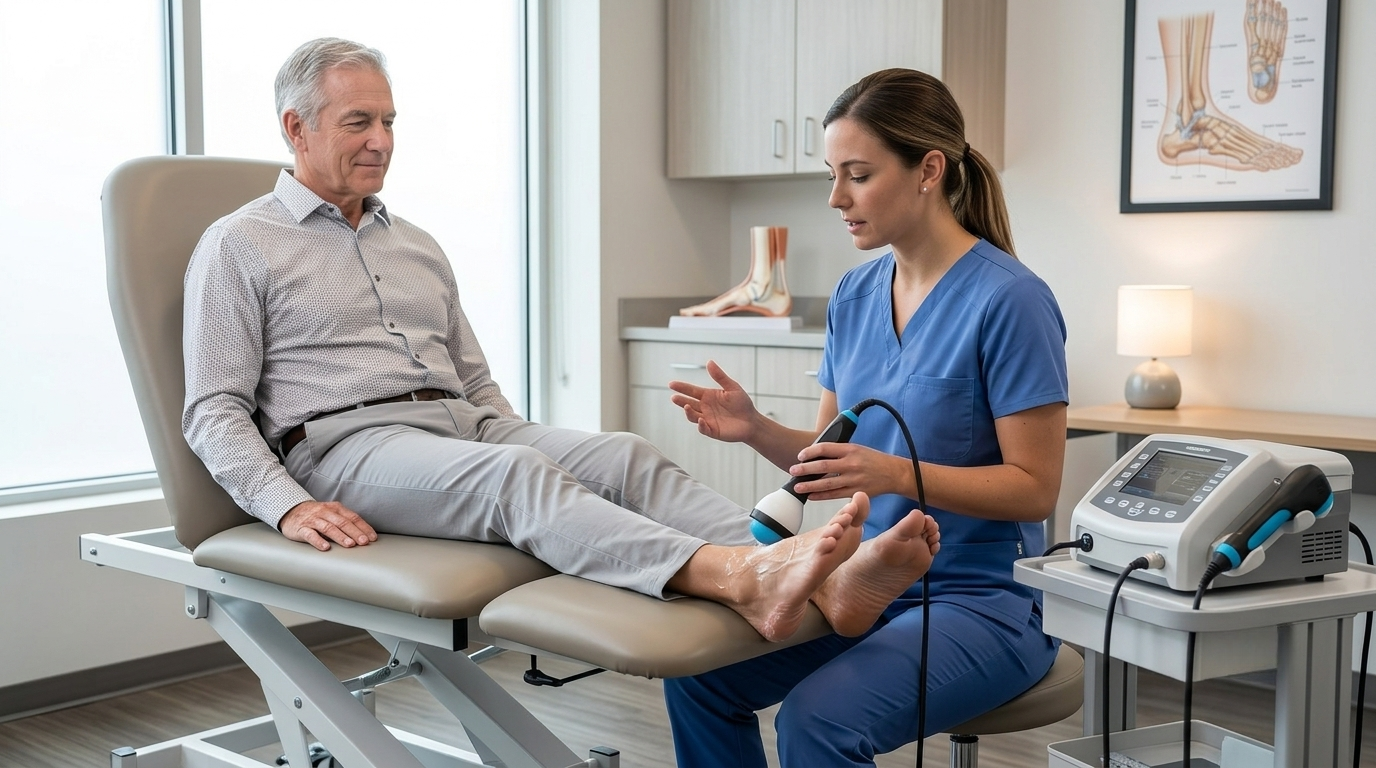
It helps to know what’s coming before your first visit.
Before Your Appointment
Your visit starts with an evaluation to confirm shockwave therapy is a good match for your specific foot or ankle condition. Not every case qualifies, and your provider will want to rule out anything that needs a different approach first.
Once you’re cleared, no special preparation is required. You won’t need anesthesia, and you can drive yourself to and from the appointment.
During and After Treatment
During the session, your provider applies a small handheld applicator directly to the affected tissue and delivers a series of controlled pulses tailored to your targeted area and pain tolerance. Most patients feel a tapping or pulsing sensation rather than sharp pain.
Afterward, you’re free to resume normal activities right away, though your provider may suggest easing off high-impact exercise for a day or two while the area settles. At Wisconsin Foot & Ankle Clinic, StemWave® care plans typically include eight to twelve sessions, with the schedule tailored to your condition and response to treatment.
Who Is a Good Candidate for Shockwave Therapy?
Shockwave therapy tends to work best for patients dealing with a chronic issue rather than a brand-new injury, particularly when more conservative options haven’t fully resolved the pain.
Signs You Might Be a Good Candidate
- Your pain has lasted more than a few weeks despite rest, stretching, or basic conservative therapy
- You’ve been told your options are “wait it out” or consider surgery, and you’d like a middle path
- You’re motivated to stay active and want to avoid a lengthy surgical recovery
- Your imaging or exam shows the kind of soft tissue degeneration that responds well to this treatment
When Shockwave Therapy Isn’t the Right Fit
Shockwave therapy isn’t appropriate for every situation. It’s generally not recommended during pregnancy, near active infection, for patients on certain blood thinners, or when a tendon has torn completely rather than simply degenerated. Your provider will walk through your history carefully before recommending it, which is exactly why this decision should be made with a foot and ankle specialist rather than guessed at on your own.
If chronic foot or ankle pain has been holding you back, it’s worth finding out whether shockwave therapy could be part of your path forward. Wisconsin Foot & Ankle Clinic‘s team can evaluate your specific situation, walk you through what to expect, and help you decide whether this treatment fits your goals. A conversation with a specialist is a small first step, but for a lot of patients, it’s the one that finally gets them moving again. When you’re ready, reach out to our team to schedule a consultation.


